

By Manjeet Singh, Education Consultant | Last updated: 29 November 2026 | Reading time: 12 minutes
BSc Agriculture admission is one of the most searched topics for students who finish Class 12 with Agriculture, Biology or Maths and want a practical, job-linked degree. This guide puts everything in one place: who is eligible, which entrance exam to prepare for, how the process works, what the course costs, what you will study and where the degree can take you.
We wrote it for students and parents who are tired of conflicting information online. Every fee figure comes from the fee structure of the institute we assist. Every eligibility rule is checked against official admission notices wherever possible, and we say clearly where rules differ between universities.
A note on timing: the rules below follow the 2026 admission cycle. Dates for 2027 had not been announced when this guide was updated, so always confirm the latest notice before you apply.
In this guide
- BSc Agriculture admission at a glance
- What is BSc Agriculture (Hons.)?
- BSc Agriculture eligibility: who can apply
- BSc Agriculture admission process, step by step
- BSc Agriculture admission timeline
- How to prepare for the entrance exam
- Documents required for admission
- BSc Agriculture fees and the real four-year cost
- How to choose the right college
- What you study in four years
- Career scope after BSc Agriculture
- Scholarships and education loans
- BSc Agriculture vs related courses
- Common mistakes to avoid
- Checklist before you pay any admission fee
- Conclusion
- Frequently asked questions
BSc Agriculture admission at a glance
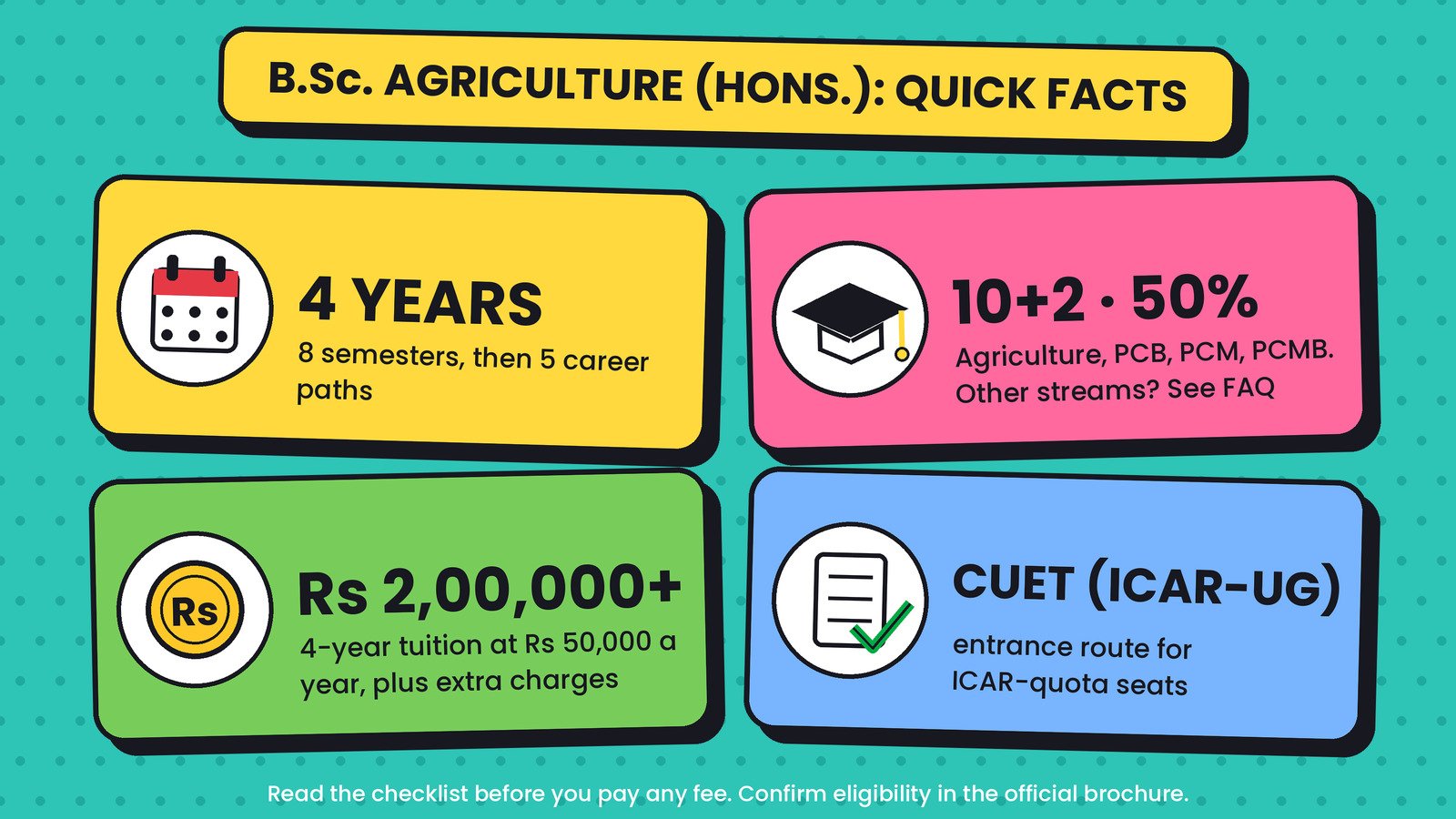
- Course: BSc (Hons.) Agriculture, a 4-year degree with 8 semesters.
- Eligibility: 10+2 with Agriculture, PCB, PCM or PCMB, usually with at least 50% marks.
- Entrance exam: CUET (ICAR-UG) for ICAR-quota seats. Other seats follow state tests, CUET-UG or merit.
- Yearly fee at the institute we assist: Rs 50,000, plus Rs 16,000 additional charges and Rs 5,000 security money.
- Four-year tuition: Rs 2,00,000 at an unchanged yearly fee.
What is BSc Agriculture (Hons.)?
BSc Agriculture is an undergraduate degree in the science of growing crops and managing land, water, soil and farm businesses. The “Hons.” tag means the programme is the full four-year professional degree, not a short three-year course.
Students learn how plants grow, how soil stays fertile, how pests and diseases are controlled and how farm produce reaches the market. The course mixes classroom theory with laboratory work and time on a real farm.
Most seats for BSc Agriculture admission sit in agricultural universities, central universities and private universities that offer the course. The degree is recognised for government jobs, bank jobs and higher studies when it is awarded by a recognised university.
BSc Agriculture eligibility: who can apply
Eligibility is the first filter in any BSc Agriculture admission. The usual rules are simple, but each university can set its own cut-offs.
Qualification. You need a Class 12 pass (10+2 or Intermediate) from a recognised board.
Subjects. Agriculture, or a science combination of PCB, PCM or PCMB. Some universities also accept vocational agriculture streams. Students from Arts or Commerce are generally not eligible unless the university offers a bridge route.
Marks. Most ICAR-pattern notices ask for at least 50% in Class 12. Reserved categories often get relaxation, commonly around 40 to 45%. Some universities ask for more, so read the brochure of the university you want.
Age. The minimum age is usually 16 years on a cut-off date given in the notice. Check the exact date, because a few months can decide eligibility.
Nationality and domicile. Indian nationals can apply to all seats. State quota seats usually need a domicile certificate.
Can PCM students apply?
Yes, in most universities. PCM, PCB and PCMB are all commonly accepted for BSc Agriculture admission. The practical difference is the entrance paper you choose, so match your subjects to the exam notice.
Is attendance in Class 12 compulsory?
Most universities need a regular Class 12 pass. Open school candidates should ask the admission office in writing before paying any fee.
BSc Agriculture admission process, step by step
The process looks long, but it breaks into five steps. Following them in order avoids the most common mistakes.
- Read the official notice. Every university publishes an admission notice and brochure. Eligibility, seats, dates and fees are all there.
- Register for the entrance exam. For ICAR-quota seats, the route is CUET (ICAR-UG), conducted by the National Testing Agency. Other seats may use state agriculture tests, CUET-UG or Class 12 merit.
- Appear for the exam and get your score. Your rank decides which seats you can reach in counselling.
- Take part in counselling. You fill choices of university and course, get a seat allotment, and accept or reject it within the dates given.
- Verify documents and pay the fee. Pay only after your seat is confirmed in writing, and keep every receipt.
How CUET (ICAR-UG) fits in
ICAR runs a national route so that students from every state can compete for ICAR-quota seats in agricultural universities. The official information bulletin lists the programmes, eligibility, exam pattern and dates. Read it fully before registering, because paper choices depend on your Class 12 subjects.
What if I miss the main round?
Many institutes run spot rounds or later rounds for vacant seats. Ask the admission office about dates, and never assume a seat is gone before checking.
BSc Agriculture admission timeline: what to do and when
Planning early removes most of the stress. This is a typical year for a student who wants BSc Agriculture admission in the next session. Exact dates change every year, so confirm them in the official notices.
- Class 12 year, first half: Shortlist five to eight universities and read their last brochures. Note the eligibility, fee and seat details.
- Early in the new year: Watch for the CUET (ICAR-UG) registration notice. Registration windows are short, so keep your photo, signature and ID scans ready.
- Spring: Complete Class 12 board exams and the entrance exam. Do not let one exam damage preparation for the other.
- After results: Prepare for counselling. Keep documents verified and choose your preferences carefully.
- Summer: Attend counselling rounds, accept a seat, pay the fee through official channels and complete joining formalities.
Students who plan their BSc Agriculture admission in Class 11 or early Class 12 usually feel calmer and make better choices.
How to prepare for the BSc Agriculture admission entrance exam
Good preparation for BSc Agriculture admission is simple and steady. You do not need an expensive course to start.
Start with your Class 11 and 12 books. Biology, Chemistry and Physics or Maths, depending on your stream, carry most of the weight. Read the chapters line by line, then solve questions at the end.
Know the exam pattern. The official information bulletin tells you the number of questions, marking scheme and subjects. Practise in the same format.
Solve previous papers and mock tests. Time yourself. After each test, list the topics you lost marks in and revise those first.
Revise weekly. Short weekly revision beats a long cramming session in the last month.
Do not ignore current agriculture topics. Reading about crops, soil and farm schemes helps in the interview and in college.
Documents required for BSc Agriculture admission
Keep scanned and original copies ready before counselling starts. A missing paper can cost you a seat.
- Class 10 and Class 12 marksheets and passing certificates
- CUET (ICAR-UG) or other entrance scorecard and admit card
- Transfer or migration certificate, as the university requires
- Category, EWS or disability certificate, if you claim a relaxation
- Domicile certificate for state quota seats
- Aadhaar card and a valid photo ID
- Recent passport-size photographs
- Medical fitness certificate, where asked
- Anti-ragging affidavit, which universities collect under UGC rules
Check that the name and date of birth are identical on every document. A small spelling difference is the most common reason for delays.
BSc Agriculture fees and the real four-year cost
Fees are where most students get surprised during BSc Agriculture admission. Here is the fee structure of the institute we assist, with the totals worked out.
| Item | Amount (Rs) |
|---|---|
| Yearly fee | 50,000 |
| Additional charges | 16,000 |
| Security money | 5,000 |
| First-year total (50,000 + 16,000 + 5,000) | 71,000 |
The tuition alone for four years is Rs 2,00,000, if the yearly fee never changes. The final cost depends on two things the fee sheet does not spell out: whether the additional charges repeat every year, and whether the security money is refundable.
| Case | Four-year total (Rs) |
|---|---|
| Additional charges paid once, security paid once | 2,21,000 |
| Additional charges paid every year, security paid once | 2,69,000 |
These totals leave out hostel, mess, books, uniforms, travel and field-training costs. Ask for those in writing as well.
How to compare BSc Agriculture fees fairly
Do not compare only the yearly fee. Compare the four-year total, the refund policy and what is included. A cheaper yearly fee with high yearly charges can cost more than a higher fee with nothing extra.
Government and aided agricultural universities usually charge much less than private universities, but seats are fewer and competition is higher. A good plan for BSc Agriculture admission is to apply to both kinds.
How to choose the right college for BSc Agriculture admission
A good college matters more than a famous name. Look at these points before you decide.
- Recognition and affiliation. Confirm the awarding university and that the course is approved. Check this on the university website, not only in a brochure.
- Farm and labs. Agriculture is learned by doing. Ask about the college farm, soil and plant labs and the machinery students actually use.
- Faculty. Look for teachers with agriculture degrees and field experience.
- Practical training tie-ups. Ask where students do their rural work experience and agro-industry attachment.
- Placement and alumni. Ask for real examples of where past students work. Be careful with large claims that come without names or proof.
- Fees and hostel. Compare the four-year total cost, not only the yearly fee.
- Location. A campus close to farms and agri-industries gives better exposure.
If possible, visit in person and speak to current students without a staff member present.
What you study in four years
The exact syllabus depends on the university, but the structure is similar everywhere.
Year 1: foundations. Basic agronomy, soil science, plant biology, agricultural economics, statistics, computer basics and communication skills.
Year 2: core subjects. Crop production, horticulture, plant breeding, entomology, plant pathology, soil fertility and farm machinery.
Year 3: applied subjects. Crop protection, farm management, post-harvest handling, agricultural marketing, extension education and electives.
Year 4: practical training. Most programmes end with a long rural work experience and attachment with agro-industries or farms, along with project-based learning modules.
Skills you build
- Reading soil and water reports
- Planning a crop calendar and input budget
- Diagnosing pests and plant diseases
- Using farm tools, drip systems and basic machinery
- Preparing a farm business plan
- Explaining new techniques to farmers
These skills matter in every career path below, including jobs that are not on a farm.
Career scope after BSc Agriculture
A BSc Agriculture degree opens more doors than most students expect. Here are the main directions.
1. Government jobs. State agriculture departments hire agriculture officers and field officers through state public service commissions and other recruitment exams. Central bodies hire for research and extension roles. Always check the current notification for eligibility.
2. Banking and insurance. Banks recruit specialist officers who understand farm credit. Examples include agricultural field officer posts through bank recruitment exams and development bank roles. Crop insurance companies also hire agriculture graduates.
3. Private companies. Seed, fertiliser, crop-protection and agri-equipment companies hire graduates for sales, field trials, product development and technical support.
4. Agri-business and startups. Food processing, organic farming, agri-tech and farm-to-market ventures all need people who understand both farming and business. Government schemes such as agri-clinic and agri-business centre training exist for agriculture graduates, so check the latest eligibility with the implementing agency.
5. Higher studies. You can go on to an M.Sc. in a specialised agricultural subject, a PhD in research, or an MBA in agri-business. Higher degrees lead to research, teaching and senior management roles.
Is BSc Agriculture a good career choice?
It is a good choice if you enjoy practical, outdoor and applied science, and if you are ready to build skills beyond the textbook. Careers in this field reward people who combine technical knowledge with communication and business sense. We do not quote salary figures here, because they vary widely by employer and region.
Scholarships and education loans for BSc Agriculture students
Money should not stop a deserving student. Several support options exist, but each has its own rules.
- Scholarships. Central and state governments run scholarships for SC, ST, OBC, minority and economically weaker students. Many are applied for through the National Scholarship Portal. Some universities also give merit scholarships to top rankers.
- Education loans. Banks offer education loans for recognised courses, and the Vidya Lakshmi portal lets you apply to several banks at once. Ask about the interest rate, moratorium period and collateral before you sign.
- Fee instalments. Some institutes allow semester-wise payment. Ask for this in writing.
Check eligibility, income limits and deadlines on the official portal, and never pay an agent to “guarantee” a scholarship.
BSc Agriculture vs related courses
Students often confuse BSc Agriculture with other agriculture-linked courses. This table shows the main differences.
| Course | Main focus | Usual stream needed |
|---|---|---|
| BSc (Hons.) Agriculture | Crops, soil, farm management, extension | Agriculture, PCB, PCM or PCMB |
| BSc Horticulture | Fruits, vegetables, flowers, landscaping | Usually PCB or Agriculture |
| B.Tech Agricultural Engineering | Farm machinery, irrigation, processing technology | PCM |
| BSc Forestry | Forests, wildlife and natural resources | Usually PCB or PCM |
If you like biology and farming, BSc Agriculture fits. If you like machines and design, look at agricultural engineering. If you want to work with fruits and flowers, consider horticulture.
Common mistakes to avoid in BSc Agriculture admission
- Applying without reading the brochure. Cut-offs and subjects differ by university.
- Missing the registration window. Entrance exam dates are strict, and late forms are not accepted.
- Choosing only by fee in BSc Agriculture admission. A low fee with weak recognition or poor farm facilities is a poor deal.
- Paying on verbal promises. Seat, fee and refund promises must be in writing.
- Ignoring practical training facilities. Ask about the college farm, labs and rural work experience.
- Forgetting backup options. Apply to more than one university and keep a spot round plan.
Checklist before you pay any admission fee
Use this checklist before you transfer a single rupee.
- Ask for the fee structure in writing, with a clear break-up of every charge.
- Confirm that the course and the awarding university are recognised, and check the university website yourself.
- Get the refund and cancellation policy in writing before payment.
- Ask whether additional charges repeat every year and whether the security money is refundable.
- Pay only through traceable modes and keep every receipt, admission letter and email.
- Visit the campus if you can, and meet students who study there.
- Never rely on verbal promises about seats, placements or fee waivers.
Conclusion: is BSc Agriculture admission right for you?
BSc Agriculture admission is a strong choice if you like applied science, are comfortable working outdoors and want a degree that leads to government, banking, corporate or entrepreneurial careers. Start early, read the official notices and compare the four-year cost before you commit.
If you want help shortlisting colleges or understanding the BSc Agriculture admission process for your situation, use the call or WhatsApp numbers at the end of this article.
Frequently asked questions
What is BSc Agriculture admission eligibility? You need a Class 12 pass with Agriculture, PCB, PCM or PCMB, usually with at least 50% marks. Reserved categories often get relaxation, and each university can set its own cut-off.
Is an entrance exam compulsory for BSc Agriculture admission? For ICAR-quota seats, yes, through CUET (ICAR-UG). For other seats, admission can be through state tests, CUET-UG or merit, as the university notifies.
What is the fee for BSc Agriculture admission? At the institute we assist, the yearly fee is Rs 50,000, plus Rs 16,000 additional charges and Rs 5,000 security money. Four-year tuition is Rs 2,00,000 if the fee stays unchanged.
Can PCM students take BSc Agriculture? Many universities accept PCM, PCB, PCMB and Agriculture. Confirm the rule in the current brochure, because it is set by each university.
Can Arts or Commerce students apply? Generally the course needs Agriculture or science subjects in Class 12. Some universities allow other streams with bridge courses, so ask the university directly.
How long is the course after BSc Agriculture admission? Four years, divided into eight semesters, including practical training in the final year.
Is the fee refundable if I withdraw? That depends on the institute’s refund policy. Get it in writing before you pay.
Related reading
For more guides on courses, careers and admissions, visit our education articles and the main legal and education blog. You can also read about the organisation behind this website.
Disclosure
Manjeet Singh provides admission guidance for the institute whose fee structure is quoted in this article. Fees are as supplied by the institute for the current structure and can change. Eligibility rules differ between universities and years, so always confirm them against the official admission brochure and notice before applying. This article is general information, not legal advice.
Sources
- ICAR and NTA: Information Bulletin for CUET (ICAR-UG) 2026
- Central Agricultural University, Imphal: B.Sc. (Hons.) Agriculture admission notice (eligibility pattern)
- CollegeDekho: B.Sc. Agriculture eligibility by university (RPCAU, PAU and others)
Talk to us
Manjeet Singh
Education Consultant
Call or WhatsApp: 9811993953 | 8700237256